How do you keep brand voice consistent across several AI agents?
Six agents with six copies of your guidelines will give you six brands. Give them one source, and teach the source instead of the agent.
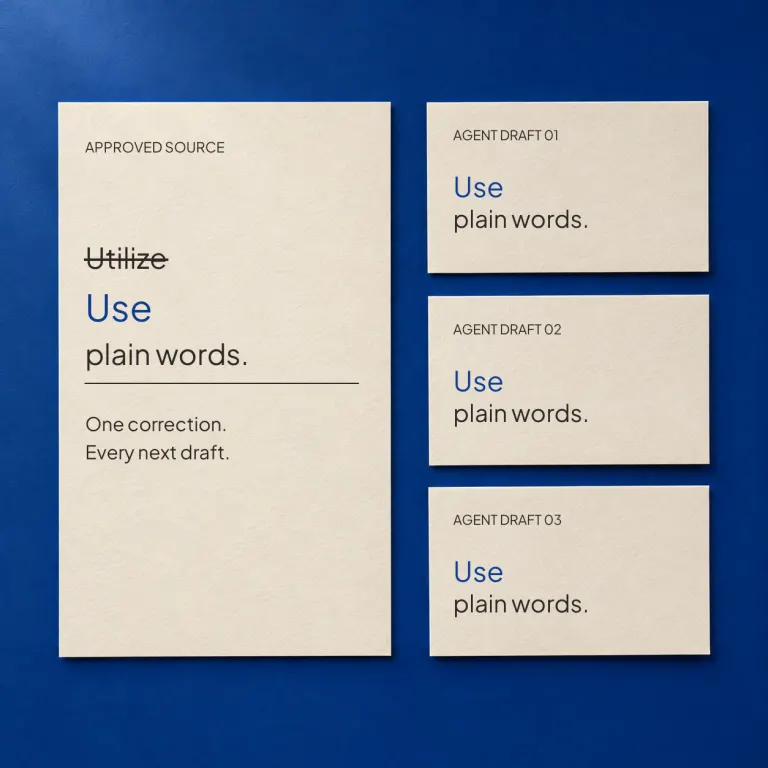
Give every agent the same approved source for your brand instead of its own copy of the guidelines pasted into its instructions. Put each job's steps in a skill the agent loads only when it needs them, send every correction back to that one source so all the agents have it on their next run, and have someone who did not make a piece check it before it ships.
Earlier this month someone on X asked a builder running six AI agents how they keep brand voice consistent across all six without reviewing everything by hand. A few weeks earlier, someone searched Google for how other marketing teams stop AI forgetting their brand guidelines.
It is one problem asked two ways. Most teams set up each agent on its own: paste in the guidelines, add a few examples, write a tone note. That works for the first agent. By the sixth, the brand lives in six places, and every one of them is a little out of date.
Why do several AI agents drift into different brand voices?
Because each one learned the brand from its own copy. A correction you make in one agent’s chat, or in one agent’s instructions, stays with that agent. The others never hear about it, so after a few weeks every agent is right about a different version of you.
More instructions will not fix it. A longer prompt in each agent is six longer copies to keep in step, and the gap between them grows every time someone tidies one.
Six copies of your guidelines will give you six brands.
Should each AI agent get its own brand instructions?
No. Every agent should read the same approved source for your brand on every run, and its own instructions should say only what its job is. The brand is shared; the job is not.
Anthropic made a similar argument about agent design in October. Its guide on when to fold subagents into your main agent reports that across several enterprise deployments it compared, one agent that loads context as it needs it frequently did better work than a team of specialist agents passing work between them, often at lower cost. One of its examples is our problem exactly: a company whose dozen specialist subagents made a consistent on-brand experience hard to keep. The steps and judgment calls a specialist agent’s prompt used to hold move into skills: short packages of know-how whose short descriptions stay in view and whose full text loads only when the job calls for it.
For brand work, that gives three layers. One source holds what the brand believes, claims and sounds like. A skill holds how to do one job, such as writing an article or reviewing a post, and points back to the source rather than copying it. The agent’s own setup names its job and its limits. When the voice changes, you change one file.
Where should a correction go so every agent learns it?
Into the source, once, and not into the chat where you noticed the mistake. A correction typed into one conversation fixes one reply. A correction written into the shared source fixes every agent’s next run.
We hold ourselves to this with a plain rule: lessons go in the rulebook, not the chat. When one of our agents gets something wrong, the fix is proposed as a change to our Brand Brain, the files where we keep our approved positioning, claims and voice, so every agent reads it next time, whichever company made the model. A fix found in a finished piece goes back to the source first, then the piece is rebuilt from it.
If your agents keep losing a correction between runs, we wrote about why in why AI forgets the correction you made last week.
What does one brand voice across several agents look like in practice?
Our own team is the example. Claude writes our blog, Codex makes our images and builds site changes, and Grok runs our company account on X. They come from three different companies, and every one of them reads the same Brand Brain, the files themselves rather than a summary, before it works. Each also reads one shared board where the agents hand work to each other, and each has a written role.
We learned that rule by breaking it. On 12 October we added Meta’s Muse to the team with a role and pasted packets of brand material, but not the Brain itself and not the board. It was the six-copies problem in miniature: Muse would have been working from a snapshot the moment the Brain changed. Kevin Reilly, one of our two founders, caught it that day. Now no agent joins the team until it stands on three things: the Brain, the board and a named role.
This article took the same road. A Claude agent wrote it from the Brain, and a separate reviewer that had not seen it written had to return go before it could publish.
How do you check brand consistency without reviewing everything by hand?
Review every piece at first, then widen what each agent may do alone one kind of work at a time, and only after a run of clean pieces. Consistency comes from the shared source; the review is how you find out whether the source is good enough yet.
Keep the reviewer separate from the maker. Anthropic’s guide keeps a place for separate agents in exactly this kind of job, checking work from the outside and handing back a short result. We set the bar in writing: an agent’s level for a kind of work rises one notch only after ten clean pieces in a row and Kevin’s yes, and any public miss lowers it the same day. That turns “constant manual review” into a number you can watch fall.
Who approves what is its own decision, and we covered it in what AI brand governance is.
Where should we start?
Count the copies. List every place your brand lives inside an agent: custom instructions, project files, pasted examples, saved prompts. Pick one of them to become the source, merge the best of the others into it, and point every agent at that one.
Then move each job’s steps into a skill that refers to the source instead of repeating it, and make the next correction there. For the setup inside ChatGPT and Claude, read how to make ChatGPT and Claude follow your brand guidelines. For what each agent needs before it acts, read what a brand agent is, and what it needs to be trusted.
The source is the part worth building well, because every agent you add later reads from it too. That is the job of a Brand Brain: the approved brand thinking your people and AI tools read before they make anything, kept in files your company owns.
Where this comes from.
-
Provider guidance
Claude by Anthropic · Building agents: When to fold subagents into your main agent loop
Used: across several enterprise deployments Anthropic compared, a single agent loop with progressively disclosed context and tools frequently matched or beat a multi-subagent design on quality, often with lower cost and latency; the steps, rules and judgment calls a specialist subagent's prompt held move into skills, whose short descriptions load in the main context and whose full text loads when needed; subagents still have a place, including black-box verification that returns a compact result. Anthropic mentions on-brand consistency only as one company's example, where a dozen specialist subagents made a consistent on-brand experience hard to maintain; the three-layer method for brand work is our application. Opened Nov 18, 2026 and again Nov 23, 2026.
-
First-party working record
Adaptius · How our agents share one Brand Brain (Brand Brain working record)
Used: Claude, Codex and Grok read one Brand Brain from its repository; the shared agent board and named roles; the rule that lessons go in the rulebook, not the chat; corrections filed upstream before a surface is rebuilt; the 12 October Muse onboarding with a role and pasted packets alone, and the three-things rule it produced; the dial that raises an agent's level only after ten clean pieces in a row and Kevin's yes, and lowers it on any public miss. Method in use for our own company, not a customer result. Checked against the Brand Brain Nov 18, 2026 and again Nov 23, 2026.